Molecular Hydrogen
Alkaline Water and Hydrogen Water Are Not the Same Thing
What Alkaline Water Actually Is
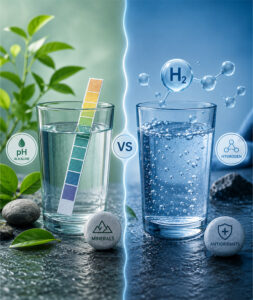
Alkaline water refers to the pH of the water.
pH is a measure of how acidic or alkaline a solution is, on a scale of zero to fourteen. Neutral is seven. Anything above seven is alkaline.
Some naturally occurring mineral waters are alkaline because of the minerals they contain. Water can also be made alkaline through electrolysis in a water ioniser, or by adding alkaline minerals directly.
Here is something worth understanding clearly.
Drinking alkaline water does not simply alkalise your body.
Your body maintains extraordinarily tight control over blood pH through sophisticated regulatory systems involving your lungs, kidneys, and chemical buffers. Blood pH is held within a very narrow range of approximately 7.35 to 7.45. Deviations beyond that range indicate serious medical conditions.
The stomach, which is highly acidic by design, neutralises most alkaline water before it reaches the bloodstream.
This is why I am cautious when I see dramatic health claims based purely on the pH of drinking water. The physiology does not support them.
What Hydrogen Water Actually Is
Hydrogen water is something different entirely.
Hydrogen-rich water contains dissolved molecular hydrogen gas. H2. Two hydrogen atoms.
The hydrogen is not chemically bound into the H2O molecule itself. It is additional H2 gas dissolved into the water, in the same way that carbon dioxide is dissolved into sparkling water.
And importantly, hydrogen water does not have to be alkaline.
You can have neutral pH water that contains meaningful concentrations of molecular hydrogen. You can also have highly alkaline water that contains very little or no dissolved hydrogen at all.
They are two separate measurements describing two separate properties.
Why the Confusion Exists
The confusion is understandable because electrolysis can produce both properties at the same time.
In an electrolytic water ioniser, reactions at the cathode produce water with a higher pH and water containing dissolved molecular hydrogen simultaneously. For a long time the conversation around this technology focused almost entirely on alkalinity, pH, and negative oxidation reduction potential, or ORP.
Molecular hydrogen research has fundamentally shifted that conversation.
A significant 2022 scientific review of electrolysed reduced water examined decades of accumulated research and concluded that the biological effects previously attributed to this water could be explained by its dissolved molecular hydrogen content rather than its alkaline pH.
That is a meaningful distinction. It means the active element researchers are interested in is the hydrogen, not the pH.
As Dr Tyler LeBaron, founder of the Molecular Hydrogen Institute and one of the leading researchers in this field, has consistently noted, the focus of rigorous hydrogen research is on the concentration of dissolved H2, how it is absorbed, how it distributes through biological systems, and what happens when it interacts with cellular processes. Alkalinity is largely incidental to that conversation.
What the Research Is Exploring
Molecular hydrogen research has grown substantially over the past two decades.
More than two thousand peer-reviewed studies have been published exploring H2 across a wide range of biological and clinical contexts. Researchers have investigated its potential influence on oxidative stress, inflammatory signalling, metabolic health, exercise recovery, cognitive function, and healthy ageing.
Some of the key published work includes:
Ohsawa et al. (2007) published a landmark study in Nature Medicine reporting that molecular hydrogen could selectively neutralise the hydroxyl radical, one of the most damaging reactive oxygen species, without interfering with other reactive molecules involved in normal cellular signalling. This finding helped establish the scientific foundation for the field.
LeBaron et al. (2019) published a systematic review examining the effects of hydrogen-rich water on health and disease across human and animal studies. The review identified encouraging findings across multiple areas while consistently noting that larger, high-quality human trials were needed to draw firm conclusions.
Ishibashi et al. (2012) examined the effects of hydrogen-rich water on inflammatory and oxidative stress biomarkers in patients with metabolic syndrome, reporting favourable changes in several markers following regular consumption.
Aoki et al. (2012) explored hydrogen-rich water in the context of exercise, reporting reductions in blood lactate levels and improvements in exercise-induced decline of muscle function in elite athletes.
The results across the body of research are intriguing but they are not definitive. Different studies use different concentrations of hydrogen, different delivery methods, different populations, and different outcome measures. Many human trials remain relatively small.
The science is evolving and I want to be honest about that.
Hydrogen water is not a cure. It is not a replacement for the foundations of health. And anyone presenting it as a miracle is not representing the research accurately.
The Question Worth Asking
For a long time the question most people asked about water was a simple one.
Am I drinking enough?
As molecular hydrogen research has developed, a more nuanced question has emerged.
What is actually in the water I am drinking?
Not the pH. Not whether it is filtered or structured or charged. But the specific composition and what the research suggests about how that composition interacts with biological systems.
For me, this is where the conversation around water becomes genuinely interesting.
Alkalinity alone does not tell you whether water contains meaningful concentrations of molecular hydrogen. An alkaline water can be entirely devoid of dissolved H2. A water ioniser that produces alkaline water may or may not be producing meaningful hydrogen concentrations depending on the technology, the water source, and the settings used.
If you are interested in hydrogen water specifically, the relevant question is how much molecular hydrogen is dissolved in the water and how quickly it dissipates after production.
Fresh hydrogen-rich water produced at the point of consumption, rather than pre-bottled water where hydrogen dissipates over time, is increasingly what researchers and practitioners interested in this area recommend.
Why I Have a Water Ioniser at Home
This is where the science became personal for me.
I am not interested in alkaline water for its own sake. The physiology around alkalinity and health claims has never fully convinced me.
What I am interested in is having access to fresh hydrogen-rich water produced at home as part of something I am already doing every day.
Drinking water.
The machine I use produces water that is both alkaline and hydrogen-rich through electrolysis. The alkalinity is a byproduct of the process. The hydrogen is what I am interested in.
Not because the science is settled. It is not.
Because it is one of the most genuinely interesting and rapidly developing areas of health research I have come across. Because the mechanism is biologically plausible in ways I find compelling. And because the foundations of health, sleep, movement, nourishing food, stress management, and hydration, are worth taking seriously at every level.
Water touches every cell in the body every single day.
That alone makes it worth understanding more deeply.
Selected References
Ohsawa, I., et al. (2007). Hydrogen acts as a therapeutic antioxidant by selectively reducing cytotoxic oxygen radicals. Nature Medicine, 13(6), 688-694.
LeBaron, T. W., et al. (2019). The effects of hydrogen-rich water on health and disease: A systematic review. Available via the Molecular Hydrogen Institute.
Ishibashi, T., et al. (2012). Therapeutic efficacy of infused molecular hydrogen in saline on rheumatoid arthritis. International Immunopharmacology.
Aoki, K., et al. (2012). Pilot study: Effects of drinking hydrogen-rich water on muscle fatigue caused by acute exercise in elite athletes. Medical Gas Research, 2(1), 12.
Ichihara, M., et al. (2015). Beneficial biological effects and the underlying mechanisms of molecular hydrogen. Comprehensive Physiology.
Ge, L., et al. (2023). Molecular hydrogen: A preventive and therapeutic medical gas for various diseases. Nature Reviews (review of mechanisms and emerging evidence).
Molecular Hydrogen Institute. Research and educational resources available at molecularhydrogeninstitute.com. Founded by Tyler W. LeBaron.
Written By Samara Jane
Wellness Coach helping women navigate burnout, stress and hormonal welbeing through sustainable self-care practices.