Molecular Hydrogen
Why Elite Athletes Are Paying Attention to the Water They Drink

BY SAMARA JANE
June 15, 2026
10 Min Read
Exploring the science of molecular hydrogen, oxidative stress, exercise performance and recovery.
At the highest levels of sport, performance is measured in remarkably small margins.
A fraction of a second can separate first place from fourth.
A subtle difference in power output can influence the outcome of a competition.
And the ability to recover between demanding training sessions can determine how consistently an athlete performs.
For decades, sports science has focused on optimising training loads, nutrition, sleep, hydration and recovery strategies.
Now, researchers are investigating another question:
Could the molecular composition of drinking water influence certain aspects of exercise performance and recovery?
One area attracting scientific interest is hydrogen-rich water, ordinary water containing dissolved molecular hydrogen gas (H₂).
The research is still developing, but findings from controlled human studies provide an interesting starting point.
Performance Begins With Adaptation
Exercise is a biological stressor.
When we train, we challenge our muscles, cardiovascular system, nervous system and metabolic processes.
The body responds by activating pathways involved in repair, adaptation and improved physical capacity.
Resistance training can stimulate changes in muscle strength and size.
Endurance training can improve mitochondrial function, oxygen utilisation and cardiovascular efficiency.
But these adaptations depend on an important relationship between training stress and recovery.
Training provides the stimulus.
Recovery allows the body to respond to that stimulus.
Without sufficient recovery, accumulated fatigue can interfere with training quality, physical performance and long-term adaptation.
This is why recovery has become such an important part of sports science.
And one of the biological processes researchers examine is oxidative stress.
Oxidative Stress: An Essential Part of Exercise Physiology
During physical activity, the body naturally produces reactive oxygen species (ROS).
These molecules are sometimes referred to as free radicals, although not all ROS are free radicals.
They are often discussed in the context of cellular damage, but their biological role is considerably more complex.
At appropriate concentrations, ROS participate in essential cellular signalling.
They help regulate pathways involved in mitochondrial adaptation, antioxidant defence and the body’s response to exercise.
In fact, a degree of exercise-induced oxidative stress is necessary for normal training adaptations.
The challenge arises when reactive species production exceeds the body’s capacity to maintain redox balance.
Under these circumstances, excessive oxidative stress may contribute to cellular damage, altered muscle function and impaired recovery.
This creates an interesting scientific question.
Can excessive oxidative stress be moderated without interfering with the signalling processes that make exercise beneficial?
A 2026 review examining antioxidants and exercise adaptation reinforced the importance of this balance. It found that antioxidant interventions can influence recovery and training adaptation differently depending on the compound, dose, timing and exercise context.
This is one reason researchers are increasingly interested in approaches that may influence redox signalling rather than simply suppressing all reactive oxygen species.
Where Molecular Hydrogen Enters the Conversation
Molecular hydrogen is the smallest and lightest molecule.
It consists of two hydrogen atoms joined together: H₂.
When dissolved into drinking water, it creates what is commonly called hydrogen-rich water.
Unlike electrolytes, vitamins or carbohydrates, molecular hydrogen is not an essential nutrient used as a building block for the body.
Instead, scientists are investigating how H₂ may interact with biological systems.
Because of its small size and physical properties, molecular hydrogen can diffuse rapidly across biological membranes.
Early research investigated its potential antioxidant activity.
More recent work has explored possible influences on redox-sensitive signalling, inflammatory pathways, endogenous antioxidant responses and cellular metabolism.
The precise mechanisms remain under investigation.
For exercise scientists, these properties have prompted interest in whether hydrogen-rich water might influence fatigue, exercise tolerance or recovery-related biomarkers.
What Does the Human Research Actually Show?
Perhaps the most useful evidence comes from studies that examine measurable outcomes rather than theoretical mechanisms alone.
A 2024 Meta-Analysis: 27 Publications and 597 Participants
A systematic review and meta-analysis published in Frontiers in Nutrition in 2024 examined 27 publications involving 597 participants.
The researchers assessed several performance-related outcomes, including aerobic endurance, anaerobic endurance, muscular strength, explosive power, perceived exertion and blood lactate.
The results were mixed.
Molecular hydrogen supplementation was associated with a small statistically significant improvement in lower-limb explosive power.
It was also associated with lower ratings of perceived exertion and reduced blood lactate measurements during exercise.
However, the analysis did not find statistically significant improvements in maximal oxygen uptake, aerobic endurance, anaerobic endurance or muscular strength.
This distinction is important.
A reduction in perceived exertion may indicate that exercise feels less demanding under certain experimental conditions.
Changes in blood lactate may suggest an effect on exercise-related metabolic responses.
Neither finding, on its own, establishes faster muscle repair or better long-term athletic performance.
The authors concluded that larger, more rigorous studies were needed to confirm the results.
A 2021 Study: Trained Cyclists and Anaerobic Performance
Another controlled study, published in Biology of Sport in 2021, examined 37 trained and untrained participants.
Using a double-blind crossover design, researchers compared seven days of hydrogen-rich water consumption with placebo water.
The hydrogen-rich water contained approximately 1.9 mg/L of dissolved H₂.
Among the trained cyclists, researchers observed improvements in anaerobic performance following the hydrogen-rich water intervention.
Mean power output increased from approximately 350 watts to 380 watts, while peak power also improved.
However, comparable improvements were not observed in the untrained participants.
The findings suggest that training status may influence responses to hydrogen-rich water.
Nevertheless, the study was relatively small, the intervention lasted only seven days, and the crossover design did not include a washout period.
These limitations matter when interpreting the findings.
A 2025 Trial Involving Elite Female Athletes
More recently, a randomised, double-blind, placebo-controlled trial published in 2025 investigated hydrogen-rich water in 22 elite female athletes participating in handball and skeleton sports.
The researchers examined measures related to muscle damage, recovery and physical performance.
The study reported favourable findings in selected muscle-damage and power-endurance outcomes.
This is particularly relevant because research involving genuinely elite athletes remains relatively limited.
However, a sample of 22 athletes cannot establish that the same effects will occur across different sports, training environments or populations.
The findings provide a useful reason for further investigation rather than definitive evidence for widespread adoption.
Why the Difference Between Biomarkers and Performance Matters
One of the most important principles in scientific research is distinguishing between a biological marker and a meaningful outcome.
Researchers may measure changes in oxidative stress markers, inflammatory proteins, blood lactate or muscle-damage enzymes.
These measurements can provide valuable information about physiological responses.
But a change in a biomarker does not automatically mean an athlete will recover faster, perform better or experience fewer injuries.
For example, lower blood lactate after exercise does not necessarily indicate reduced muscle damage.
Lactate is an important metabolic intermediate and fuel, not simply a waste product responsible for soreness.
Similarly, changes in inflammatory markers do not automatically translate into improved training adaptations.
The most convincing evidence would demonstrate consistent improvements in meaningful outcomes such as performance, recovery time, training capacity or sustained adaptation.
And this is where molecular hydrogen research still has important questions to answer.
Why Hydrogen Concentration and Timing Matter
Hydrogen-rich water also presents practical considerations that differ from conventional hydration.
Molecular hydrogen is a dissolved gas.
Over time, H₂ can escape from water, particularly when containers are opened or water is exposed to the atmosphere.
Consequently, the amount of molecular hydrogen originally produced may differ from the amount present when the water is consumed.
For research purposes, several variables become important.
The concentration of dissolved H₂ or the volume consumed.
The timing of consumption relative to exercise and the duration of the intervention.
The method used to produce and store the water.
These factors make comparisons between studies more complicated.
They also highlight an important distinction between ordinary hydration and hydrogen-rich water.
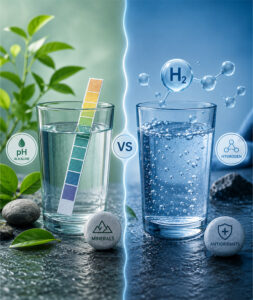
The pH of water does not tell us how much molecular hydrogen it contains.
Alkaline water and hydrogen-rich water describe different properties, even though some electrolysis-based water ionisers can produce water with both characteristics.
For someone interested specifically in molecular hydrogen, the concentration of dissolved H₂ is therefore a more relevant measurement than pH alone.
Researchers have not yet established a universally effective concentration or consumption protocol for exercise performance or recovery
The Bigger Picture: Recovery Is a System
Although molecular hydrogen is an interesting area of research, the strongest foundations of recovery remain well established.
Adequate sleep supports physiological restoration and adaptation.
Appropriate nutrition provides the energy and nutrients required for tissue maintenance and training responses.
Hydration helps maintain normal physiological function, temperature regulation and exercise capacity.
Progressive training, appropriate recovery periods and stress management also influence performance over time.
Hydrogen-rich water is being investigated within this broader landscape.
It is not a substitute for the fundamentals.
And current evidence does not justify presenting it as an essential recovery intervention.
However, the emerging research raises worthwhile questions about whether dissolved molecular hydrogen could have a useful role in particular training or recovery contexts.
Those questions deserve rigorous investigation.
What Elite Sport Can Teach the Rest of Us
Most of us are not preparing for an Olympic final.
We are not measuring every fraction of a second or monitoring our daily power output.
But the principles of adaptation and recovery are relevant well beyond elite sport.
Our bodies respond to physical activity, sleep, nutrition, psychological stress and the demands of everyday life.
And maintaining the capacity to respond to those demands is an important part of long-term wellbeing.
Perhaps one of the most useful lessons from sports science is that performance is rarely the result of one extraordinary intervention.
It develops through the interaction of many small, consistent behaviours.
The quality of training, the opportunity to recover, the food we eat or the sleep we prioritise.
And the attention we give to hydration.
Molecular hydrogen research adds another question to that conversation.
Could something as small as H₂ influence certain physiological responses associated with exercise?
The Future of Recovery Research
The science of exercise recovery continues to evolve.
Researchers are moving beyond simplistic ideas about eliminating free radicals or suppressing every inflammatory response.
Instead, they are exploring how biological systems regulate stress, maintain balance and adapt to repeated challenges.
Molecular hydrogen is one of several emerging areas being investigated within this field.
Some controlled studies have reported encouraging findings.
Others have shown limited or inconsistent effects.
The next stage of research will need to establish whether those findings are reproducible, clinically meaningful and relevant across different populations.
For now, perhaps the most useful approach is informed curiosity.
Understanding what the evidence shows.
Recognising what remains uncertain.
And appreciating that the foundations of wellbeing are built through choices we make consistently.
Because whether we are training for elite competition or simply wanting more energy for the people and experiences that matter to us, recovery deserves our attention.
Research and References
Zhou, K., et al. (2024). Can molecular hydrogen supplementation enhance physical performance in healthy adults? A systematic review and meta-analysis. Frontiers in Nutrition, 11, 1387657.
https://doi.org/10.3389/fnut.2024.1387657
Timón, R., et al. (2021). Effects of 7-day intake of hydrogen-rich water on physical performance of trained and untrained subjects. Biology of Sport, 38(2), 269–275.
https://doi.org/10.5114/biolsport.2020.98625
Hydrogen-Rich Water Decreases Muscle Damage and Improves Power Endurance in Elite Athletes: A Randomized, Double-Blinded, Placebo-Controlled Trial. (2025). Journal of Lifestyle Medicine, 15(1), 8–17.
https://doi.org/10.15280/jlm.2025.15.1.8
Antioxidants and Exercise: A Redox-Informed Framework for Training Adaptation, Performance, and Recovery. (2026). Antioxidants, 15(4), 456.
https://doi.org/10.3390/antiox15040456
Educational note: Molecular hydrogen research is ongoing. Hydrogen-rich water has not been established as a treatment for exercise-related injury, fatigue or other medical conditions, and should not replace established hydration, nutrition, training or recovery practices.

Written By Samara Jane
Wellness Coach helping women navigate burnout, stress and hormonal welbeing through sustainable self-care practices.
Categories
- Molecular Hydrogen
- Mindset
- Build Your Life
Stay Connected
Receive weekly wellness insights, selfcare rituals and practical tools.
Recent Posts
Why Elite Athletes Are Paying Attention to the Water They Drink

Maybe Wealth Was Never the Point

Have You Designed Your Week, or Just Filled It?

Five Years From Now, What Do You Want to Leave Behind?

Neuroplasticity: How Your Brain Rewires Through Repeated Thought and Action
Alkaline Water and Hydrogen Water Are Not the Same Thing

What will your future self thank you for?



You do not need anyone’s permission

What actually happens when you drink hydrogen water

Maybe money was never the point


The Real Cost of Staying